

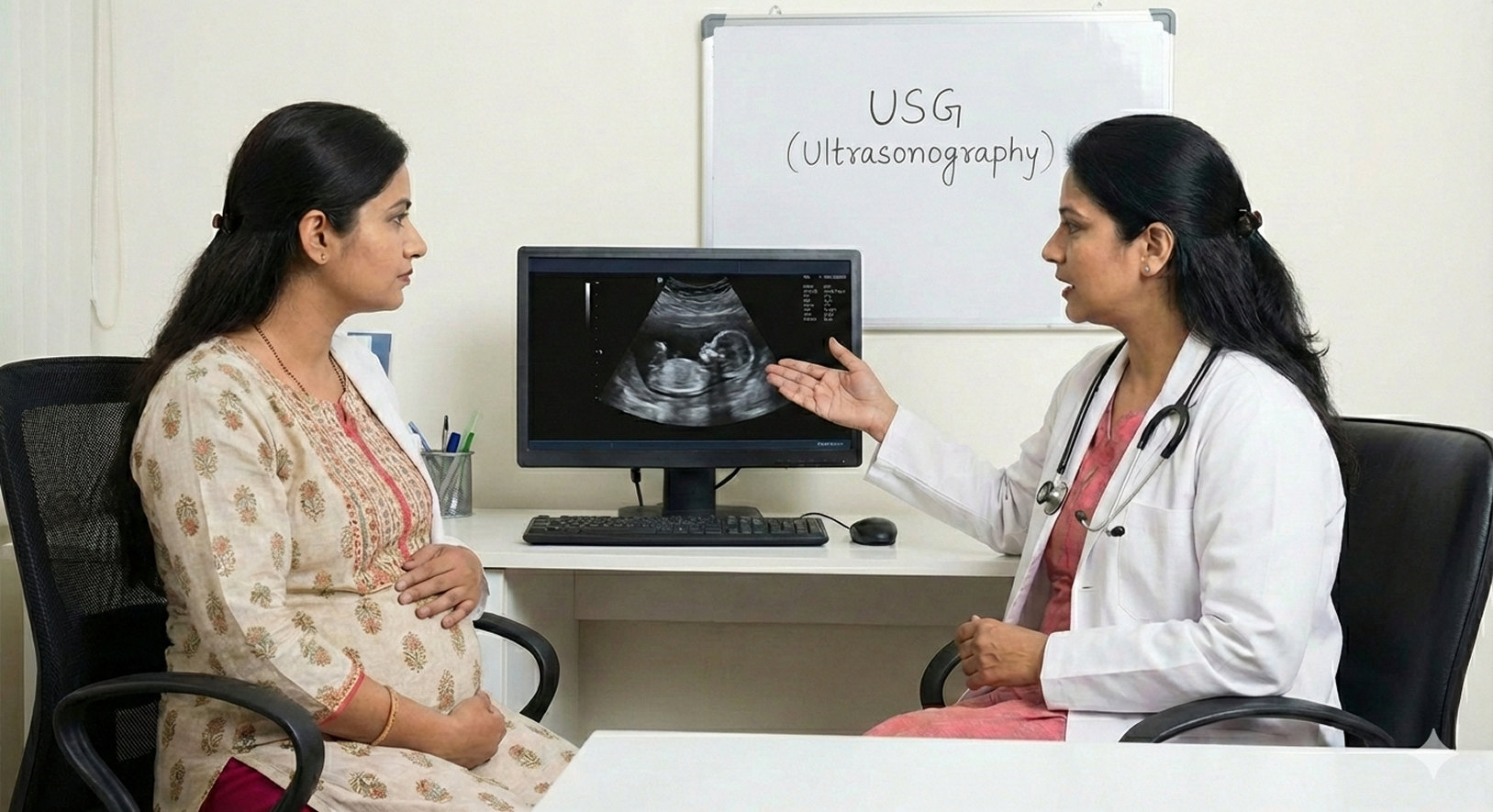


A few weeks ago, a first-time mother-to-be sat in my clinic, clutching her prescription slip with a slightly puzzled look on her face. She pointed to three letters I had scribbled: USG.
“Doctor,” she asked, “I know I need a scan, but what is USG exactly? And why do I need so many?”
Her question was a perfectly valid one, and it took me back to my early days as an obstetrician-gynaecologist. I realised that I’d gotten so used to medical shorthand in my clinic that I’d forgotten acronyms like these should be expanded upon. So, if you’ve been searching for “USG full form in pregnancy” or wondering why it’s the gold standard in prenatal care, I’m writing this blog just for you.
Decoding the Term: USG Full Form in Pregnancy
Before we dive into the pregnancy journey, let’s clear up the terminology. The USG full form in pregnancy is Ultrasonography. While many patients simply call it an “ultrasound,” the term USG is what you will most commonly see on your medical reports and doctor’s notes.
So, what is USG? Well, it’s a non-invasive diagnostic technique that uses high-frequency sound waves to create real-time images of the inside of your body. Unlike X-rays, USG doesn’t use radiation, making it the safest way for us to peek inside the womb and check on your little one’s development.
Its Vital Role
In my experience, the USG functions both as a medical test and as a window into your baby’s world. As your pregnancy doctor, I use these scans to monitor milestones that we simply cannot check through a physical exam alone.
USG usually refers to a series of scheduled scans throughout your three trimesters. They’re pretty significant for a few reasons:
- Confirming the Pregnancy: In the early weeks, a USG confirms the pregnancy is in the right place (the uterus) and checks for a heartbeat.
- Dating the Pregnancy: It helps us calculate your due date with incredible accuracy, something that is vital for planning your care.
- Monitoring Growth: We use it to measure the baby’s head, abdomen, and limbs to ensure they are growing at a healthy rate.
- Anatomy Checks: Around the 20-week mark, we perform a detailed “anomaly scan” to check the baby’s organs, spine, and heart.
- Placenta and Fluid Levels: The scan also tells us where the placenta is located and if there’s enough amniotic fluid to cushion the baby.
My Approach
When a woman walks into my clinic, I know that every scan she undergoes can bring about feelings of excitement or anxiety, or sometimes both. My role as an obstetrician-gynaecologist is to guide you through these moments with honesty and care.
Going in-depth about USG by explaining it to my patients reassures them when they see that tiny flickering heartbeat for the first time, as they can then fully understand the otherwise complex images on the screen. I believe in an informed approach that empowers you with the knowledge you need for a stress-free pregnancy.
Is USG Safe?
This is perhaps the most common concern I hear. I want to reassure you that USG applications for pregnancy have been used for decades with an excellent safety record. As it uses sound waves (rather than ionising radiation), there is no known risk to you or your baby, especially when it’s done by trained professionals.
Preparation For Your Scan
As your pregnancy doctor, I always tell my patients that a little preparation goes a long way in getting the best images:
- Be Hydrated: For early scans, a full bladder can help lift the uterus for a clearer view.
- Wear Comfortable Clothing: Wear a two-piece outfit so we can easily access your abdomen.
- Ask Questions: Don’t hesitate to ask your obstetrician-gynaecologist to point out the baby’s features.
- Bring Your Partner (Or any available family member): It’s a beautiful moment that always goes over best with family present.
Some Final Thoughts
The journey to motherhood is filled with milestones, and USG is an essential map that guides us doctors between each of them.
If you‘re looking for a gynaecologist near you to help navigate your pregnancy or have more questions about USG, I am here to help you every step of the way. I believe everyone’s journey should start with being well-informed. Something that, in my experience, is a necessary precedent for a truly wonderful experience entering motherhood.
FAQs
1. What is USG full form in pregnancy?
The USG full form in pregnancy is Ultrasonography. It is a scan used to monitor the health and development of the fetus and the mother’s reproductive organs.
2. What is USG, and is it different from an ultrasound?
In common conversation, there is no difference. It is simply the medical abbreviation for the ultrasound procedure.
4. How many USG scans are normal during pregnancy?
Most healthy pregnancies involve around 4 major scans: the dating scan, the NT scan, the anomaly scan, and a growth scan. However, your pregnancy doctor may recommend more (only) if you have a high-risk condition.
5. Does USG hurt?
Not at all. It is a painless procedure where a cold gel is applied to your skin, and a small device (called a transducer) is moved over your abdomen. You might feel some slight pressure at the very worst.
6. When should I get my first USG?
Typically, the first scan is done between 6 and 10 weeks to confirm the pregnancy and check the heartbeat. Early consultation with your obstetrician-gynaecologist will help determine the best schedule for you.